When John Henry Elliott Bennett edited the rolls of the freemen of Chester in 1906 for the Record Society’s Volume 51, he used two main sources. The first was the city’s Mayors Books, which record all sorts of business and include admissions to the freedom because only the mayor had the authority to perform the ceremony. The second was a series of contemporary rolls that simply listed freemen year by year as they were admitted. Starting in 1392, sometimes the information in the two sources overlapped, for some years one existed but not the other, and in some cases both were missing or damaged. Bennett also obtained a copy of a contemporary list that is now in the British Library (Harley MS 2105), which allowed him to supplement information for one particular mayor’s term of office in 1505-06.
What he did not realise was that other similar lists existed from the reign of Elizabeth I (Harley MS 2093), and it turns out that for a number of years in the 1560s they give much more detailed information than the sources Bennett was able to use. Bound into a volume of miscellaneous Chester material, the pages are certainly contemporary and may even be the originals that should have been bound in the official mayors’ books. For example, for 1565-6 – the mayoralty of Thomas Green – whereas Bennett only had a roll that listed the names and occupations of new freemen, the British Library manuscript gives the exact date on which each man was admitted to the freedom and also the name of his master (if he claimed his rights after serving an apprenticeship) or his father (if he was an hereditary freeman). The first entry for that year in Bennett’s list in Volume 51 is simply “Richard Johnson alias Conley, shoemaker” but the new information shows that the ceremony took place on 3 December 1565 and that Johnson had trained under William Linacre (spelled Lynacar). Linacre’s own admission – in 1551 – is recorded earlier in the published volume. Incidentally, the British Library document also shows Johnson’s alternative name to be Cowley, not Conley.

The names on the roll that Bennett used for this year appear in the same order in the published volume as they do on the dated list in the British Library manuscript, with one interesting exception. Next to the full text of the paragraphs enumerating each admission ceremony in detail, the scribe made a list of names in the margins of the document, presumably for ease of reference. He made a mistake:
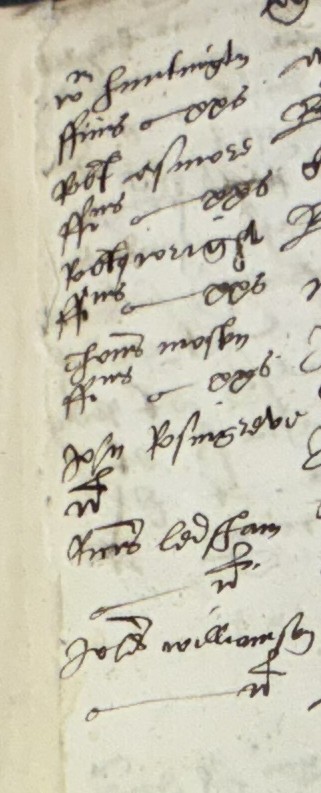
Initially, the writer accidentally missed John Williamson off the list and then corrected it by adding the name at the bottom. Bennett’s published list, taken from the freedom roll that is now in Cheshire Archives and Local Studies, perpetuates the mistake, putting Williamson’s name in the wrong order. That might give weight to the view that the British Library manuscript is the original, and that the roll was copied from the marginal list.
In most cases, the documents indicate how much each freeman paid for his admission, with 20 shillings the standard rate for “normal” candidates, who were claiming their freedom because either they had completed their apprenticeship or they were the son of an existing freeman. Men who did not meet these criteria often paid more, sometimes because their freedom was a favour to someone influential, which normally meant they had money. John Jeffery, whose status was given as a “servant of George Calveley, armiger” – a local bigwig – paid £5. But an embroiderer called Thomas Barker paid nothing at all, and was granted his freedom in consideration of the fact that Mr John Dutton of Dutton (who must have been a patron or friend of Barker) had given stones from his land “for the reparacion of the New Haven,” a disastrous project to build a quay in the Dee downstream of the city, in order to protect navigation as the river silted up.
Images © The British Library Board

